Thursday, March 26, 2009

Recognizing Warning Signs and How to Cope

Mental Health America : http://www.nmha.org/go/information/get-info/mi-and-the-family/recognizing-warning-signs-and-how-to-cope


Factsheet: Mental Illness and the Family: Recognizing Warning Symptoms and How to Cope

Most people believe that mental disorders are rare and “happen to someone else." In fact, mental disorders are common and widespread. An estimated 54 million Americans suffer from some form of mental disorder in a given year.

Most families are not prepared to cope with learning their loved one has a mental illness. It can be physically and emotionally trying, and can make us feel vulnerable to the opinions and judgments of others.

If you think you or someone you know may have a mental or emotional problem, it is important to remember there is hope and help.


Warning Signs and Symptoms

In adults:

  • Confused thinking
  • Prolonged depression (sadness or irritability)
  • Feelings of extreme highs and lows
  • Excessive fears, worries and anxieties
  • Social withdrawal
  • Dramatic changes in eating or sleeping habits
  • Strong feelings of anger
  • Delusions or hallucinations
  • Growing inability to cope with daily problems and activities
  • Suicidal thoughts
  • Denial of obvious problems
  • Numerous unexplained physical ailments
  • Substance abuse

In older children and pre-adolescents:

  • Substance abuse
  • Inability to cope with problems and daily activities
  • Changes in sleeping and/or eating habits
  • Excessive complaints of physical ailments
  • Defiance of authority, truancy, theft, and/or vandalism
  • Intense fear of weight gain
  • Prolonged negative mood, often accompanied by poor appetite or thoughts of death
  • Frequent outbursts of anger

In younger children:

  • Changes in school performance
  • Poor grades despite strong efforts
  • Excessive worry or anxiety (i.e. refusing to go to bed or school)
  • Hyperactivity
  • Persistent nightmares
  • Persistent disobedience or aggression
  • Frequent temper tantrums

How to cope day-to-day


Accept your feelings

Despite the different symptoms and types of mental illnesses, many families who have a loved one with mental illness, share similar experiences. You may find yourself denying the warning signs, worrying what other people will think because of the stigma, or wondering what caused your loved one to become ill. Accept that these feelings are normal and common among families going through similar situations. Find out all you can about your loved one’s illness by reading and talking with mental health professionals. Share what you have learned with others.


Handling unusual behavior

The outward signs of a mental illness are often behavioral. Individuals may be extremely quiet or withdrawn. Conversely, he or she may burst into tears or have outbursts of anger. Even after treatment has started, individuals with a mental illness can exhibit anti-social behaviors.

When in public, these behaviors can be disruptive and difficult to accept.

The next time you and your family member visit your doctor or mental health professional, discuss these behaviors and develop a strategy for coping.


Establishing a support network

Whenever possible, seek support from friends and family members. If you feel you cannot discuss your situation with friends or other family members, find a self-help or support group. These groups provide an opportunity for you to talk to other people who are experiencing the same type of problems. They can listen and offer valuable advice.


Seeking counseling

Therapy can be beneficial for both the individual with mental illness and other family members. A mental health professional can suggest ways to cope and better understand your loved one’s illness.

When looking for a therapist, be patient and talk to a few professionals so you can choose the person that is right for you and your family. It may take time until you are comfortable, but in the long run you will be glad you sought help.


Taking time out

It is common for the person with the mental illness to become the focus of family life. When this happens, other members of the family may feel ignored or resentful. Some may find it difficult to pursue their own interests.

If you are the caregiver, you need some time for yourself. Schedule time away to prevent becoming frustrated or angry. If you schedule time for yourself it will help you to keep things in perspective and you may have more patience and compassion for coping or helping your loved one. Only when you are physically and emotionally healthy can you help others.

“Many families who have a loved one with mental illness share similar experiences”

It is important to remember that there is hope for recovery and that with treatment many people with mental illness return to a productive and fulfilling life.


Sunday, March 15, 2009

Mental health problems and the prison population


Taken from the Department of Justice report:
Highlights from the report:

• Nearly a quarter of both State prisoners
and jail inmates who had a
mental health problem, compared to a
fifth of those without, had served 3 or
more prior incarcerations.
• Female inmates had higher rates of
mental health problems than male
inmates (State prisons: 73% of
females and 55% of males; local jails:
75% of females and 63% of males).
• About 74% of State prisoners and
76% of local jail inmates who had a
mental health problem met criteria for
substance dependence or abuse.
• Nearly 63% of State prisoners who
had a mental health problem had
used drugs in the month before their
arrest, compared to 49% of those
without a mental health problem.
• Jail inmates who had a mental
health problem (24%) were three
times as likely as jail inmates without
(8%) to report being physically or
sexually abused in the past.
• Over 1 in 3 State prisoners and
1 in 6 jail inmates who had a mental
health problem had received treatment
since admission.

Saturday, March 14, 2009

Iceland's 10 commandments of Mental Health

Here is a poster on the ten commandments of Mental Health from Iceland's Public Health Institute:


Check out their webpage here: http://www.lydheilsustod.is/stodflokkar/english/projects/mental-health-promotion/

Saturday, February 28, 2009

Substance Abuse and Mental Illness

Did you know addiction and mental illness facilitate each other? There is research that indicates addiction to drugs or alcohol can lead to mental illness and likewise, mental illness can lead to substance abuse. We know drug and alcohol addiction are bad for our brain. We have all seen the infamous commercial of an egg- "This is your brain"- and the egg frying in a pan: "This is your brain on drugs." We have all seen movies where an individual high on either methamphetamine or heroin portray schizophrenic behavior. However, did you know that someone suffering from a mental illness is more likely to abuse drugs and alcohol? Within mass media, alcohol is portrayed as a companion to a disappointed, lovesick person. Have you ever heard the phrase, "drowning your woes with alcohol?" Well, this exact behavior is called self-medication. Self-medication is the use of drugs or alcohol to relieve oneself of distress or pain. The dependence of a substance to alleviate a mental condition, can then lead to addiction- thus causing a dual diagnosis. A dual diagnosis is one where a person is suffering from mental illness and addiction to a substance. Treatment for dual diagnosis is more complicated since the individual would need to go through a detoxification period, rehabilitation, and then undergo treatment for the mental illness. For more information click here to go to the MedlinePlus website on dual diagnosis: http://www.nlm.nih.gov/medlineplus/dualdiagnosis.html

Wednesday, February 18, 2009

Mental Illness: Genetics vs Environment


Is one's mental health determined by their genetic structure or their environment? The truth is that both factors are important components to mental health. Causes of certain mental illnesses continue to be debated as whether they are genetic or environmental. Autism is one such case. A recent court decision found that vaccines do not cause autism, disappointing thousands of parents who truly believed that the MMR vaccine administered on their children led to this condition. These parents believed that a specific environmental factor caused autism in their children, however the court ruled that a vaccine was not the culprit.

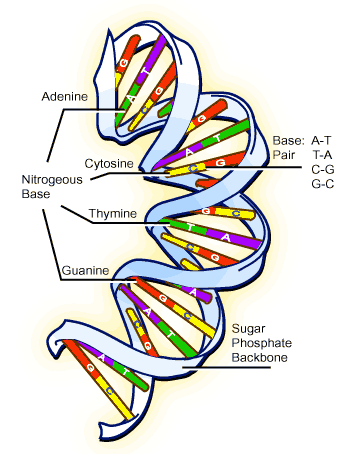
Post Traumatic Stress Disorder is a mental illness that acknowledges environmental causes. Depression is known to have genetic predisposition, as well as environmental triggers. The Environmental Health Perspectives journal has a great article on the environmental connection to mental illness (click on purple text to read it.) Linking environmental factors as underlying causes of mental illnesses would increase greater prevention and treatment strategies by targeting these causes.

The importance of environment and overall health and wellness has been increasing among health professionals. A healthy environment leads to healthy people and unhealthy environment leads to unhealthy people. The greater incidence of mental illness in current society has led many to see important connections between environment and mental health. This growing importance of healthy environments has helped many to view mental health as a community/societal issue, not solely an individual issue. Tackling mental health as a society will help to destimatize mental illness and bring awareness for treament on multiple levels- environmentally and individually.

Thursday, February 12, 2009

What is Mental Health?

Mental Health, at times, appears to be an elusive topic. Dictionary.com provides various definitions of mental health such as :

-psychological well-being and satisfactory adjustment to society and to the ordinary demands of life (Random House Dictionary,)

-A person's overall emotional and psychological condition (American Heritage Dictionary,) and

-the condition of being sound mentally and emotionally that is characterized by the absence of mental disorder (as neurosis orpsychosis) and by adequate adjustment especially as reflected in feeling comfortable about oneself, positive feelings about others, and ability to meet the demands of life (Merriam Webster Medical Dictionary.)

These definitions then add more questions: How does one measure psychological well-being, overall emotional condition, or adequate adjustment? Professionals, in this field, logically have a range of tools and tests to gauge one's mental and emotional condition. However, many do not have the ability to access professionals, and at times base mental health in terms of happiness.
Happiness, as well, being an elusive term. In this way, many people suffer with mental health conditions that they themselves don't understand and much less know that there is treatment.

The National Institute for Mental Health website (www.nostigma.org ) state that 57.7 million adults suffer from a diagnosable mental health disorder each year. In young people, 1 out of every 5 have a diagnosable mental health condition. They also state that 66% of young people with substance abuse issues also have a co-occurring mental health disorder.

What exactly is a mental health disorder? Mental Health disorders range from depression, schizophrenia, eating disorders, anxiety disorders ( phobias, post-traumatic stress disorder, obsessive-compulsive disorder), to attention deficit hyperactivity disorder. At times, symptoms are very visible, such as in prominent cases of schizophrenia, however, many times symptoms are difficult to decipher leading many people suffering with a mental health disorder to feel helpless- or worse, cause them to harm themselves or others.

View a video on mental illness stigma by clicking here: Stigma.

Lately, our national news outlets have focused on various cases linked to the individuals mental health. Last Christmas, we all heard about the case of Bruce Pardo- a gunman dressed as Santa Claus who massacred 9 people at his ex-wife's West Covina party. Pardo was described as having "snapped" after his divorce. A couple weeks ago, we all heard of an LA man who killed his children and wife, after they both lost their jobs. Currently, we are all bombarded with the case of a single mother who has birthed 14 children through insemination. Many news commentators are filling up media space questioning the mother's mental health and her ability to successfully raise her children.

These cases may be extreme examples of mental health cases, however, it is exactly these stories that detach individuals to mental health disorders. These extreme cases could led one to think that a mental health disorder is the same thing as being crazy, but this is not true. Disorders range from mild to severe symptoms. Ignoring the symptoms, however, can worsen a disorder. It is important to know that there is treatment for mental health disorders.

Mental Health is a highly stigmatized field in public health. Many people who suffer from a mental health disorder do so in silence and, at times, self-medicated with alcohol or drugs. It is important to discuss mental health disorders and symptoms, in order to put a face on this elusive term.